
Creating a Configuration
Select the Products -> Configurator menu or the  icon on the Grid toolbar to display the Configurator window.
To create a new configuration, click on the  [New] button. This opens the Configurations window.
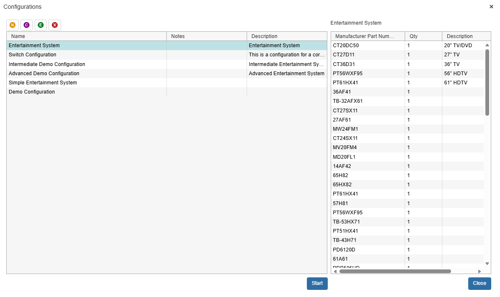
In the following window you can enter a name for the configuration:
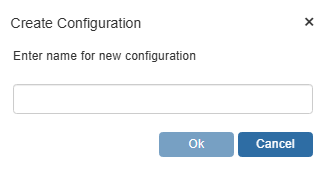
Click on the [Ok] button to save the configuration name.
To clone an existing configuration, click the  [Clone] button. Cloning is very useful for when you want to create another configuration that is mostly the same as an existing configuration, but with changes.
To edit a configuration click on the configuration name and hit the  [Edit] button.
Clicking New or Edit will open the Configurations window in which there are 6 tabs:
Settings Tab
On the Settings tab, you can modify the bundle name and set the configuration type.
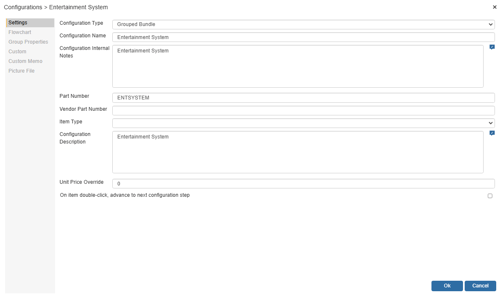
There are 2 Configuration types: Simple Configuration and Grouped Configuration.
Simple Configuration
When a simple configuration is added to the quote, all the line items will be added to the quote, with no relation to each other.
Grouped Configuration
When a grouped configuration is added to the quote, all the line items that are added will be logically grouped together.
This information is then copied into the Group Header of the configuration. It can then be used in the quote and for reporting purposes.
See Line Types and Attributes Used for Grouping for details on the logical grouping of items.
Configuration Name
The Configuration Name is the name of the Configuration. You should name it something that relates to the items that make up the Configuration so it is easier to identify. This is an internal name only and will not be displayed to the customer.
Configuration Internal Notes
The Configuration Internal Notes are internal notes about the configuration. This could be additional insight for the sales rep before they add the configuration to the document. These are not displayed to the customer.
Part Number
Set a part number for the configuration for reporting and integration purposes. It can be a custom number that is defined by you.
Vendor Part Number
Specify a Vendor Part Number for the configuration for reporting and integration purposes. It can be a custom number that is defined by you.
Item Type
The Item Type of the Configuration can be set to any of the item types you have set in QuoteWerks.
Configuration Description
The Configuration Description is the customer facing description for the Configuration header line. You will want to make sure this is something that is relevant to the customer.
Unit Price Override
The Unit Price Override allows users to specify a specific amount for the Grouped Configuration. Typically, QuoteWerks takes the total of the line items in the Configuration and calculates that as the Configuration Header total. However, in some instances you may want to round the total number. Here you can specify the exact number you wish to charge for this Grouped Configuration by typing in the amount.
NOTE: When you use this feature, the individual items that make up the Grouped Configuration's Unit Prices are adjusted to total up to the amount set here
Flowchart Tab
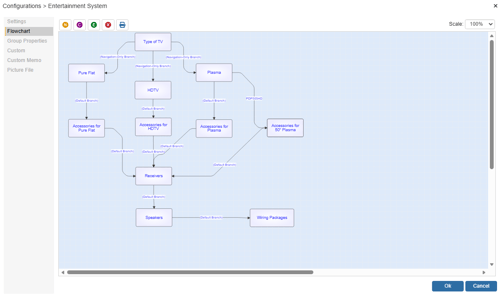
The Flowchart tab is where you will setup the steps of the configuration. You will create a selection container for each step in the configuration, then you will specify which products will be listed in the selection container, and then you will connect selection containers together to indicate the order that the steps will be presented in.
The Zoom drop down is useful when working with larger configurations, you can zoom to 50% and select the container you want to focus on and then change the zoom back to 100% and the container you selected will now be in the current viewable area.
You can print the configuration flowchart by clicking the Print  button.
NOTE: To move a selection container, click on the container and drag it to its new position.
Creating Selection Containers
Right-click in the center of the Flowchart area to display the pop-up menu. Then, select ‘Create new Selection Container' from the menu. In the next window, enter a name for this container:
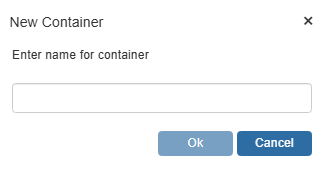
Repeat this procedure to create as many selection containers as you need. You can create all of your containers at once and then add products and/or bundles to them, or you can add products to each selection container as you create them.
NOTE: You need to assign a part number to the bundle to use it as an option
Editing a Selection Container
Right-click on a selection container and choose the Properties menu to edit the properties for the selection container:
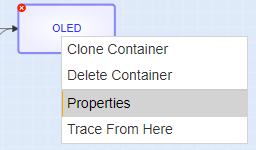
The Edit Selection Container window has 2 tabs, Settings and Items:
Settings Tab
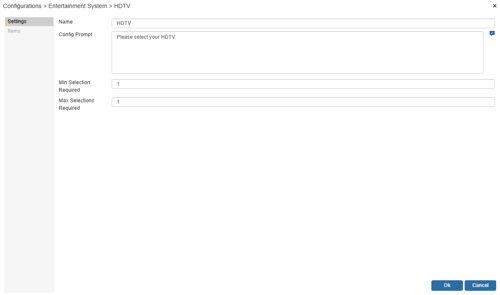
Name
This is the name of the selection container.
Config Prompt
The config prompt allows you to add some instructions or information to assist the sales rep in making their selection from this selection container. The config prompt will display when the items in the selection container are being displayed in the Administrator.
Min selection required
The Min selection allows you to control the minimum number of items selected from this container.
Max selection allowed
The Max selection allows you to control the maximum number of items selected from this container.
Items Tab
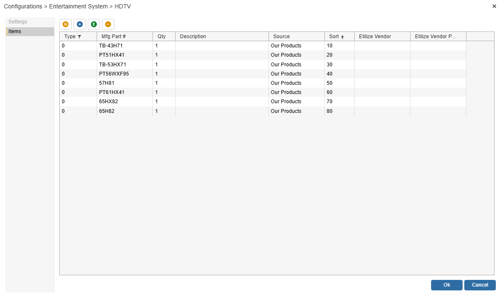
The Items tab displays a list of the products and bundles that are included in this selection container and allows you to add, edit or delete items and bundles from a selection container.
NOTE: The Items tab is the same for simple and grouped configurations.
NOTE: Items used in the Configurator must have a unique manufacturer part number.
Adding Items from Etilize
Items from Etilize can be used in the Configurator by searching for the items in Etilize or selecting them from the "My Favorites" folder underneath the Etilize Search. When adding items to a configuration from Etilize, it is important to select the vendor first before adding the item to the configuration. If the vendor is not selected, QuoteWerks will automatically use the first vendor available for that item when it's added to the configuration. Additionally, the Real-time pricing and availability will be updated for the item when it is added to the document.
Adding, Editing, and Removing an Item
From this tab you can add items to the selection container. Click on the  [Add Item] button, the Product Lookup menu will automatically appear. From there, you can search for the products associated with this selection container. Once you have found the product(s) you are looking for, select them, and click on the [Select/Add] button from the Product Lookup window to add it to the selection container.
NOTE: Whenever QuoteWerks needs you to find and select a part number, it will display the Product Lookup window. Once you have found the item(s) you are looking for, you must select the item(s), and click on the [Select/Add] button from the Product Lookup window to add the item(s) and return to the previous dialog
To edit a product in the selection container, select the item and click on the edit  button. The “Edit Selection Container Item” window will appear:
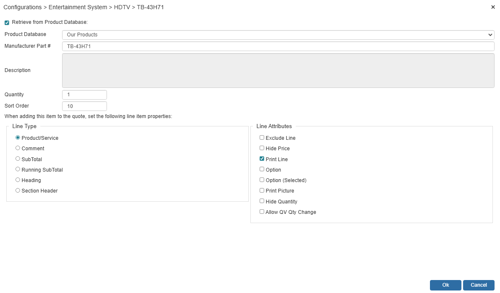
Retrieve from Product Database Checkbox
The Retrieve Product Database Checkbox will enable you to convert an item from a Product/Service type item to a Comment or Heading line instead if the item is being added to a Grouped Configuration. The advantage of this feature is that it will enable you to use the already available description of the item selected or customize it with a new description for the Configuration.
If the item is being added to a simple configuration, the other options will be available (Subtotal, Running Subtotal, Section Header) in addition to the Comment and Heading options.
Fields
The “Manufacturer Part #” is the part number of the selected item. The “Description” is retrieved from the part number definition in the product database. The Quantity field allows you to set a quantity other than the default quantity of 1. The sort code allows you to define the order in which the selection container items appear when they are added to your quote.
The Line Type and Line Attributes settings allow you to further specify the properties of the item when it is added to the quote.
To remove a product or bundle from a selection container, select the item or bundle to be removed and click on the  [Remove] button.
Connecting Selection Containers
Now that you have created the selection containers, you will need to connect them together to indicate the order in which they will be presented.
When you hover over the center of a selection container a cross hair will appear. When clicked and dragged to another selection container, it creates the link between the containers
To connect the selection containers, left-click on the container to activate the link creation handle. Then, hold the mouse button down while you drag the mouse over to the container that you want to connect this container to. Then, release the mouse, and a “Create selection-based branch” window will be displayed.
NOTE: There is an option on the Misc tab of the Setup -> My Preferences menu that lets you increase the size of the link creation handle which makes it easier to draw the links.
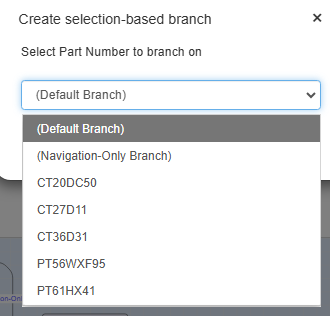
There are 3 types of branches available:
Default Branch
Use this branch type to branch to the selected container no matter what item was selected in the container.
Navigation-Only Branch
Use this branch type to branch from the selection container without actually using an item from the selection container. For example, this can be used to give the user a choice between item A and item B or OTHER. If OTHER is chosen, the user will be branched to another selection container without having selected an item from this selection container.
Part Number Based Branch
Use this branch type to branch to the container if a specific part number was chosen from the selection container. For example, if the user chose item A, it could branch to 1 selection container, and if the user chose item B, it could branch to another selection container.
Deleting a Selection Container or Branch
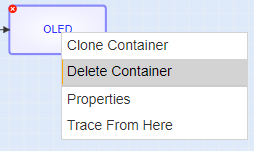
To delete a selection container, right click on the selection container that you would like to delete and select Delete Container:
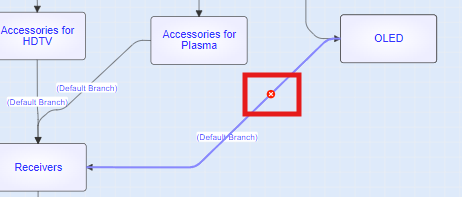
To delete a branch, left click on the branch that you would like to delete and then click on the red 'X' icon:
Group Properties Tab
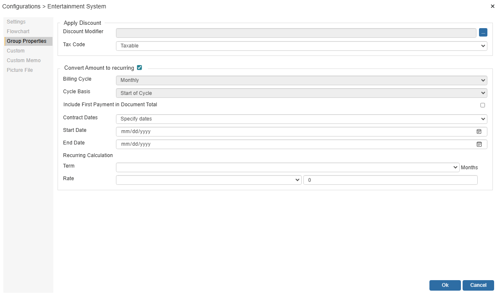
The Group Properties option enables users to set the configuration to a single recurring monthly revenue amount (Recurring Groups). All the individual items in the group are totaled and an Annual Percentage Rate (APR) and a term (e.g. 12, 24, 36 months) can be set.
This option calculates the monthly payment amount which will display in the group header’s Unit Price field when the configuration is added to the QuoteWerks document. Users can see the total recurring amount by viewing the “Group Ext. Price w. Tax Price” and “Group Ext. Price Pre-recurring” fields on the Document Items tab in the Quote Workbook.
NOTE: If you are planning on using the reporting features in QuoteWerks to report on the sales amounts of particular products sold, keep in mind that when a discount modifier is used in a configuration, the prices of the individual line items in the configuration are not individually discounted. The discount is instead subtracted from the configuration total.
Custom Tab
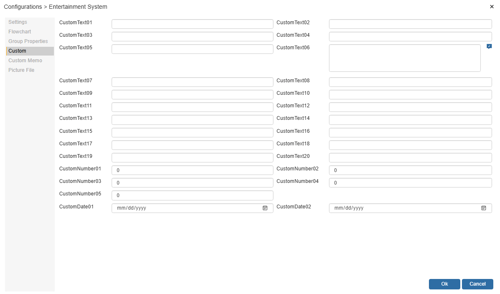
The Custom Tab for the Configurator provides an easy way to add additional information about the configuration. You can provide more details about what you are quoting out to the customer and include more details in the header line of the configuration.
There are twenty CustomText fields, five CustomNumber fields, and two CustomDate fields that can be used.
Custom Memo
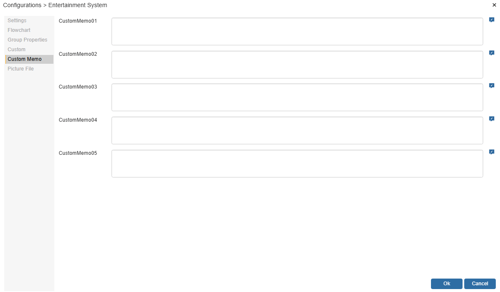
The Custom Memo fields are a where you can store additional descriptions or lengthy descriptions that are too large to fit in the Custom Text fields. Each CustomMemo field holds up to 32,000 characters.
Picture File Tab
Picture File
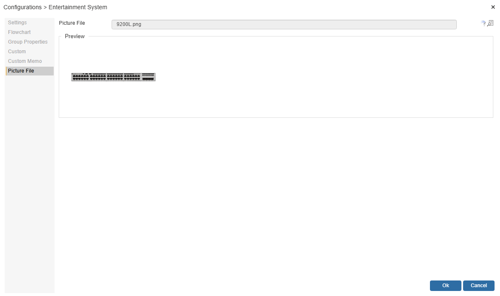
The Picture File allows you to set a picture for the Configuration header line. This will be displayed on the output of the document. The  icon will allow you to select the picture for the configuration. The
  icon will remove the picture.